
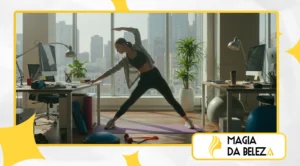
Do you know how to combat a sedentary lifestyle at work?
Advertisements
Sitting in the same position for hours seems harmless. But as the days and months go by, your body starts to show signs of tension in your shoulders that never existed before.
A tiredness in the legs that didn't bother me before. A feeling of stiffness that arrives silently.
It is at this point that the need arises for combat sedentary lifestyle at work. Not just to relieve immediate discomfort, but to take care of long-term health.
Small movements throughout the day make a real difference. And more important than finding time for big workouts is getting your body back into the routine, even in the midst of busy schedules.
In this article, you will discover simple and effective ways to keep your body active at work. Exercises that do not require special clothing or a large space, just the desire to improve your movement.
The Real Impact of a Sedentary Lifestyle in the Workplace
When we think of a sedentary lifestyle, we often imagine people who spend the whole day on the couch. But the truth is that sitting in front of a computer for eight or ten hours already characterizes a sedentary lifestyle.
And the body feels it. Blood circulation slows down. Posture deteriorates. Energy levels decrease. And over time, the risk of heart disease, back problems and even changes in metabolism increases.
According to the World Health Organization, a sedentary lifestyle is one of the main risk factors for global health. Sitting down at work is not the problem. The problem is forgetting that the body was made to move, stretch, and strengthen.
Combating a sedentary lifestyle at work is a silent commitment to quality of life. And it starts with small but powerful gestures.
Read also: 10 Daily Habits for Healthy, Radiant Skin
How Small Moves Make a Big Difference
You don’t need to turn your office into a gym to protect your body. What makes the difference is consistency. Breaking up long periods of immobility with simple movements activates circulation, maintains flexibility and awakens the mind.
Throughout the day, getting up from your chair, stretching your arms, rotating your shoulders, stretching your legs — all of these things fuel your body with new energy. And this movement isn’t just physical. It’s also mental. It refreshes your brain, improves your concentration, and reduces feelings of exhaustion.
Moving around at work is not a whim. It is a biological necessity that modern routines insist on ignoring. Bringing movement back is, in many ways, an act of reconnecting with yourself.
Simple Exercises That Change Your Routine
Combating a sedentary lifestyle can start with discreet movements that are easy to fit into natural intervals throughout the day.
Stretching your arms above your head, as if you were trying to reach the ceiling, releases tension accumulated in your shoulders. Flexing and extending your feet, even while sitting, activates circulation in your legs and reduces the risk of swelling.
Rotating your neck gently, drawing imaginary circles in the air, restores mobility to your cervical vertebrae. Inhaling deeply, filling your lungs with air and releasing it slowly, renews your breath and calms your mind.
Even on busy days, setting aside two minutes every hour for some type of movement can transform your body’s relationship with work. And this transformation is subtle but powerful: less pain, more energy, more body awareness.
Simple Exercises That Change Your Routine
Combating a sedentary lifestyle can start with discreet movements that are easy to fit into your daily routine. Stretching your arms, stretching your legs, or breathing deeply is a good start. But if you want to make your practice even more effective, some simple exercises can help a lot.
1. Seated Spine Stretch
Your spine suffers when you sit for hours. To relieve this tension, sit up straight, interlace your fingers and stretch your arms above your head, as if you were trying to reach the ceiling.
Hold this position for a few seconds and breathe deeply. This movement helps to realign your posture and brings more lightness to your back.
2. Alternating Knee Raises
Still sitting, lift one knee at a time towards your chest, holding it lightly with your hands if necessary.
This simple movement activates circulation in the legs, prevents swelling and brings more mobility to the hips, which become very stiff during long periods of sitting.
3. Shoulder Rotation
Tension in the shoulders builds up silently. Slowly rotating them, first backwards and then forwards, loosens up this overworked area.
Inhale as you raise your shoulders and exhale as you roll them back. A short exercise that renews the feeling of freedom in the upper body.
4. Ankle Flexion
Feet and ankles also suffer from immobility. To reactivate circulation, stretch one leg out in front of you and move your ankle in circles, first to one side, then to the other.
Alternate between both feet. A simple gesture that can be done even while making a phone call or quickly reading emails.
5. Lateral Trunk Stretch
While sitting or standing, raise one arm above your head and gently tilt your torso to the opposite side. Hold the position for a few seconds and then switch sides.
This movement stretches the lateral muscles of the body, improves spinal mobility and breaks the feeling of stiffness that a day of inactivity usually brings.
The Body Responds When You Take Care of It
The beauty of incorporating exercise into your work routine is that your body responds almost immediately. A simple stretch can relieve aches and pains that seemed like an inevitable part of your day. A three-minute break can give you the energy you need to finish a difficult task.
And the effect goes beyond the moment. Those who incorporate the habit of moving during work tend to have fewer postural problems, fewer episodes of lower back pain and a faster recovery from physical fatigue.
It's like watering a plant. A little water, distributed regularly, keeps it alive. The human body, despite all its complexity, responds in the same way.
Movement doesn’t have to be exhausting to be effective. It needs to be regular, mindful, and done gently.
Movement is an Act of Self-Care
Many people associate self-care with moments reserved for after work. A trip to the spa, a massage scheduled for the weekend, a planned break. But true self-care happens in the silent choices of everyday life. Those that, in the midst of the rush, affirm that the body matters too.
Standing up to stretch between tasks. Taking a deep breath when your chest tightens with tension. Stretching your spine after hours of hunched over your desk. These small actions may seem almost invisible, but they are profound gestures of self-respect.
Combating a sedentary lifestyle at work is more than just maintaining good posture or relieving pain. It’s about remembering, with every movement, that you’re not just your mind and production. You’re your body, your breath, your presence.
And the more movement becomes part of your daily routine, the less it feels like an obligation. It becomes a natural rhythm. A break that doesn’t interrupt your productivity — it just renews it.
Over time, these breaks leave their mark. Not on your body, but on the way you feel inside it.
Because taking care of yourself doesn’t have to wait until the end of the day. Or the weekend. Every stretch, every extra step in the hallway, every conscious breath is a silent reminder: your well-being is now.
Frequently Asked Questions About Combating a Sedentary Lifestyle at Work
Is it possible to combat a sedentary lifestyle even if you work sitting down all day?
Yes. Combating a sedentary lifestyle at work starts with incorporating small, regular movements, such as stretching and short walks, which can help reduce the impacts of a sedentary lifestyle.
How much should I move around during work hours?
The ideal is to take breaks every 30 to 60 minutes. Even two minutes of movement can bring real benefits to circulation and posture.
What type of exercise is best suited for office workers?
Stretching, joint rotations and short walks within the work environment are practical and very effective.
Is it necessary to do intense exercise to get benefits?
No. Light, frequent movements are enough to activate circulation, reduce muscle tension and improve your mood.
What to do if the work environment does not allow for long breaks?
Take advantage of possible moments: stand up while talking on the phone, stretch your arms while reading emails, or walk to another area instead of sending a message.