
How to correct imperfections with contouring and highlighting

Correct imperfections with contouring and highlighting is the key to flawless makeup. The technique goes far beyond simply darkening and brightening areas of the face.
Advertisements
Well, it's a true art of illusionism. Using light and shadow to sculpt the face, highlighting strengths and disguising imperfections.
In other words, this is a powerful strategy for those seeking harmony. It's not about changing who you are, but about celebrating your unique beauty.
Mastering this technique can transform your makeup routine. It's a play of light and shadow.
Makeup becomes an instrument of self-esteem and expression.
Advertisements
The Play of Light and Shadow
The essence of contouring and highlighting lies in how light interacts with the face. Dark areas create depth.
Highlights bring attention. Shadows recede while light advances.
In other words, it's like sculpting a work of art. You define the volume and lines of the face. Contouring uses darker tones. They should be one or two shades lighter than your skin tone.
On the other hand, highlighter should be clear and radiant. This dynamic duo creates a three-dimensional effect on the face.
Choosing Products
Likewise, the quality of the products is crucial to the results. Cream and powder contours have different textures.
Creams are ideal for dry skin and a more natural finish. Powders, on the other hand, are better for oily skin and a more dramatic effect.
At the same time, knowing your skin type helps you choose. An unsuitable product can compromise application.
Highlighters also vary. Liquid or creamy highlighters offer a subtle glow, while powder highlighters provide intense highlights.
The texture of the products must be homogeneous.
Application for Facial Harmonization
Correct application is the soul of the technique. In other words, there is no single rule.
Every face has its own peculiarities. The goal is to balance the proportions.
At the same time, square faces can be softened. Apply contour to the edges of the forehead and jawline.
Read more: Glamorous makeup for evening events: step by step
However, round faces benefit from contouring on the sides of the face and below the cheekbones.
Highlighter should be applied to the high areas: the top of the cheekbones, the brow bone, and the Cupid's bow.
Therefore, it's an act of observation and practice. Practice makes perfect. You're in control of your own work of art.
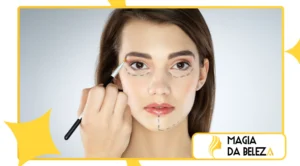
1. Nose Correction with Contouring and Highlighting
On the other hand, the nose is one of the most sculpted areas. A wide nose can be tapered.
Contour the sides of your nose. This creates the illusion of a narrower nose. Apply highlighter along the bridge of your nose in a straight line.
Find out more: Tips for maintaining a healthy posture and avoiding muscle pain
This technique makes the nose appear thinner. For a long nose, apply contour to the tip.
This visually shortens the length. It's a simple yet effective trick. The highlighter should only be applied to the upper back.
2. Enhancing Cheekbones
Defined cheekbones bring elegance. In other words, contouring should be applied below the cheekbone.
So, start near the ear, working your way toward the mouth. Don't go too far.
Use an angled brush. Apply the highlighter directly to the top of the cheekbones. It attracts light and enhances the area.
The contrast between the two areas is what creates definition. Shadows sink, light bounces. The result is a more sculpted and angular face.
Disguising a Wide Forehead and Correcting Imperfections with Contouring and Highlighting
So, imagine a person with a prominent forehead. They can use contouring to balance their facial proportions.
So, we apply contour to the hairline and sides of the forehead. This visually reduces the size of the area.
More information: Peptides in Haircare: How This Revolutionary Ingredient Strengthens the Scalp and Combats Hair Loss
Next, we highlight the center of the face. We apply highlighter to the brow bone and the top of the cheekbones.
This strategy shifts attention, focusing the gaze on the center of the face. The result is a subtle and elegant harmony.
Softening a Prominent Chin
Another common situation is a prominent chin. Contouring can be applied to the tip.
In other words, this creates a shadow that makes the chin appear less pointy. The technique is subtle and clever.
However, the outline isn't a dark spot. It's a soft shadow. It's a game of visual perception.
That's the big takeaway from correct imperfections with contouring and highlighting.

Current Research and Data on How to Correct Imperfections with Contouring and Highlighting
According to a 2024 study by beauty consultancy Mintel, 65% of makeup consumers seek products that offer multiple benefits, including the ability to sculpt and define the face, reflecting the rise in popularity of contouring and highlighting techniques.
In other words, this shows that the search for harmony is a global trend. People want more than just color. They seek form and structure.
The industry is responding to this demand with innovations. We're seeing hybrid products on the market—products that simultaneously contour and illuminate.
In other words, this evolution reflects consumer interest.
Essential Products Table
| Product Type | Function | Benefit |
| Powder Contour | Creates depth and shadow | Ideal for oily skin and matte finish |
| Cream Contour | Adds soft definition | Natural finish and ideal for dry skin |
| Powder Highlighter | Intense highlight | Striking and long-lasting shine |
| Liquid Highlighter | Subtle and natural shine | Glowy and moisturizing finish |
This table helps you understand the differences, so the right choice depends on your needs.
The Subtle Art of Correcting Imperfections with Contouring and Highlighting
Contouring and highlighting aren't masks. They're tools for enhancing your appearance.
So, think of them as the sculptor and the light of a work of art. The sculptor uses the chisel to shape it.
Light, in turn, reveals the beauty of the piece. Makeup is its chisel and its light.
Why settle for the basics when we can enhance our beauty? Makeup becomes an act of self-care.
The goal is to enhance, not hide.
Beauty is in the details. It's the subtle differences that make the big impact.
Frequently Asked Questions: Correcting imperfections with contouring and highlighting
1. What is the difference between contouring and bronzer?
Bronzer adds warmth and color to the skin, simulating a tan. Contouring is used to create shadows and define facial features.
Otherwise, the contour should be a cool tone, while the bronzer has a warmer base.
2. Can I use blush to contour?
Not recommended. Blush contains pink or reddish pigments, intended to add color. Contouring should be a neutral or cool tone to simulate a natural shadow.
3. Do I need multiple brushes for contouring and highlighting?
One or two dedicated brushes are sufficient. An angled brush for contouring and a fine-tipped or fan brush for highlighting.
Practice will help you understand which tool works best for you.
4. How do I know where to apply the contour?
The trick is to create a pout and apply the contour to the darker area that forms. For the nose, apply it to the sides, following a straight line. Practice and a mirror are your best guides.
++ Facial contouring: learn how to do makeup
++ How to contour for every face type
